About
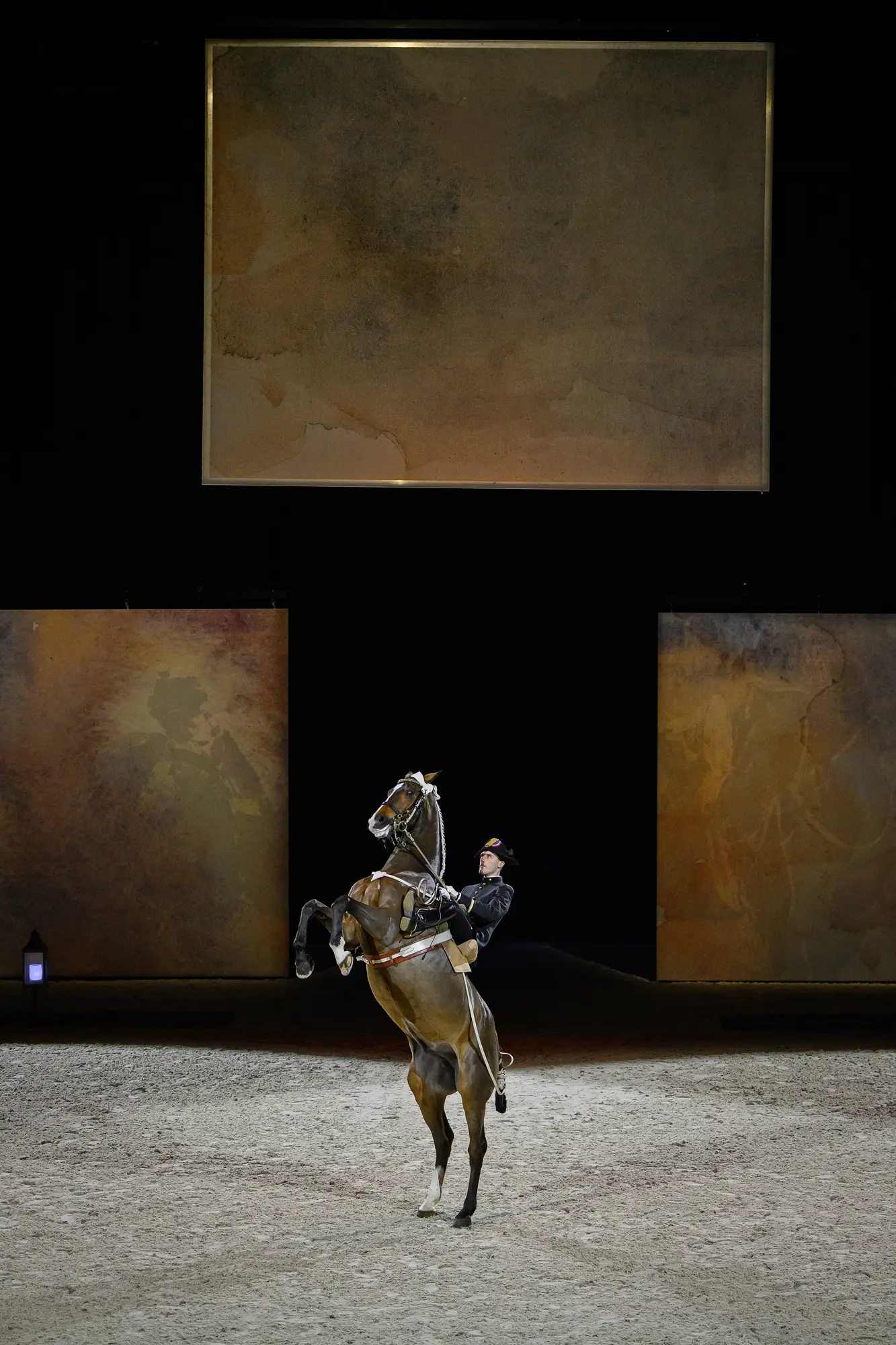
Nine monumental paintings transform through light, creating an evolving scenography for a new equestrian Gala by the legendary Cadre Noir de Saumur.
Nine monumental paintings transform through light, creating an evolving scenography for a new equestrian Gala by the legendary Cadre Noir de Saumur.
For almost two centuries, the Cadre Noir de Saumur has carried forward the tradition of French classical horsemanship, bringing horses and riders together in performances renowned far beyond its home in Saumur, France.
For a new Gala, scenographer Anne-Sophie Grac wanted to introduce monumental paintings into the scenography – not simply as a backdrop to the horses and riders performing in the arena, but as part of the storytelling itself. And she wanted those paintings to change throughout the show, without relying on video or projection.
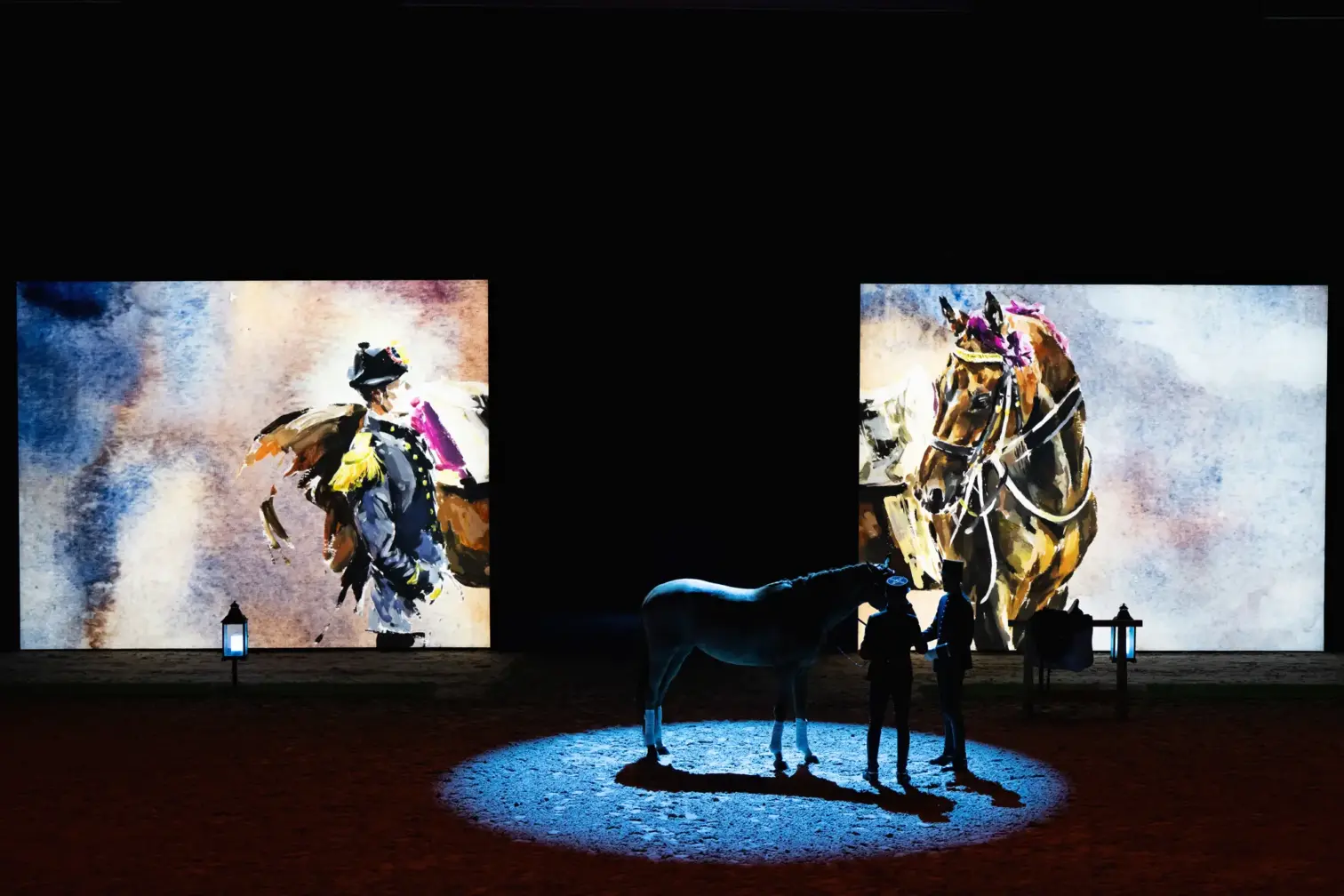
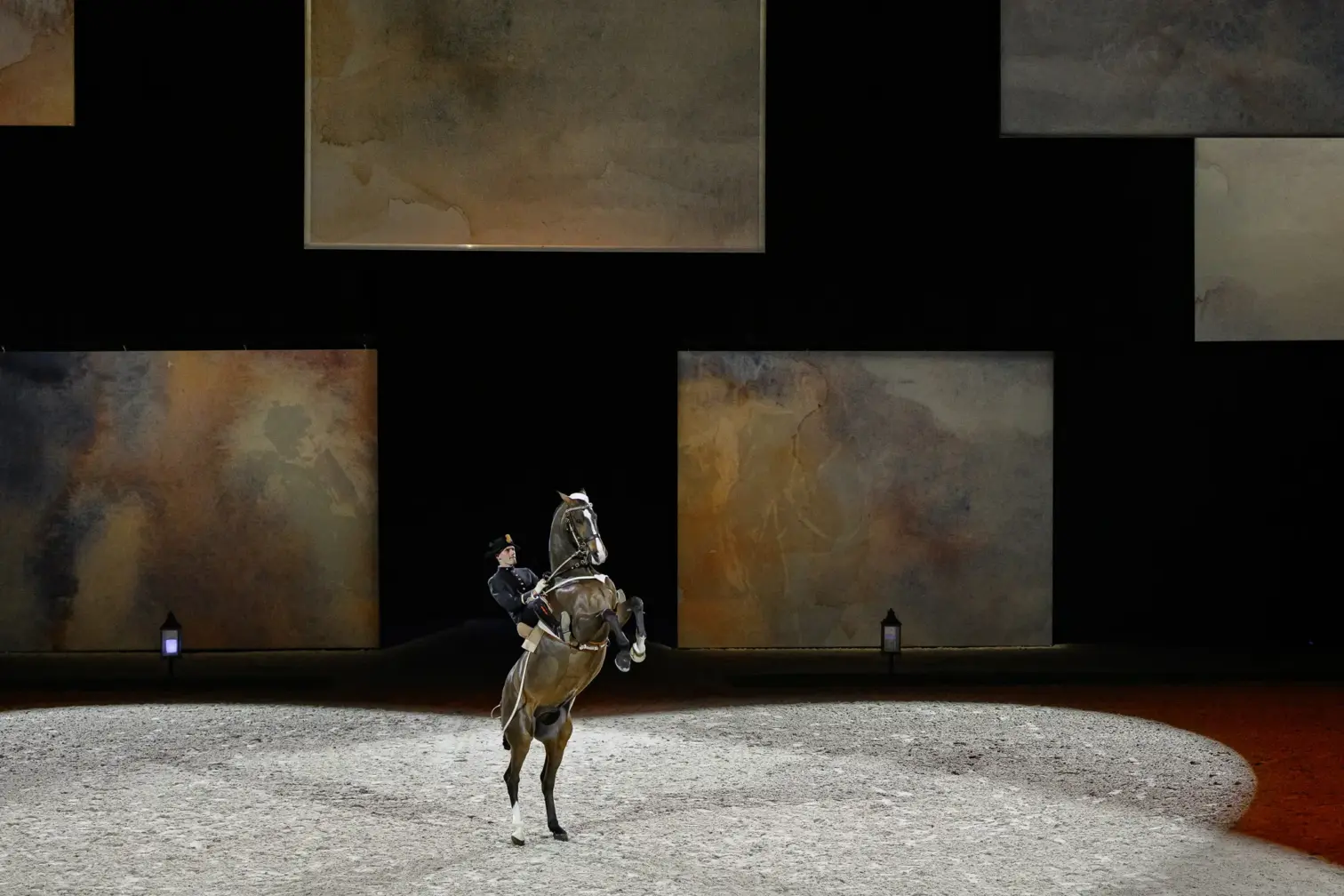
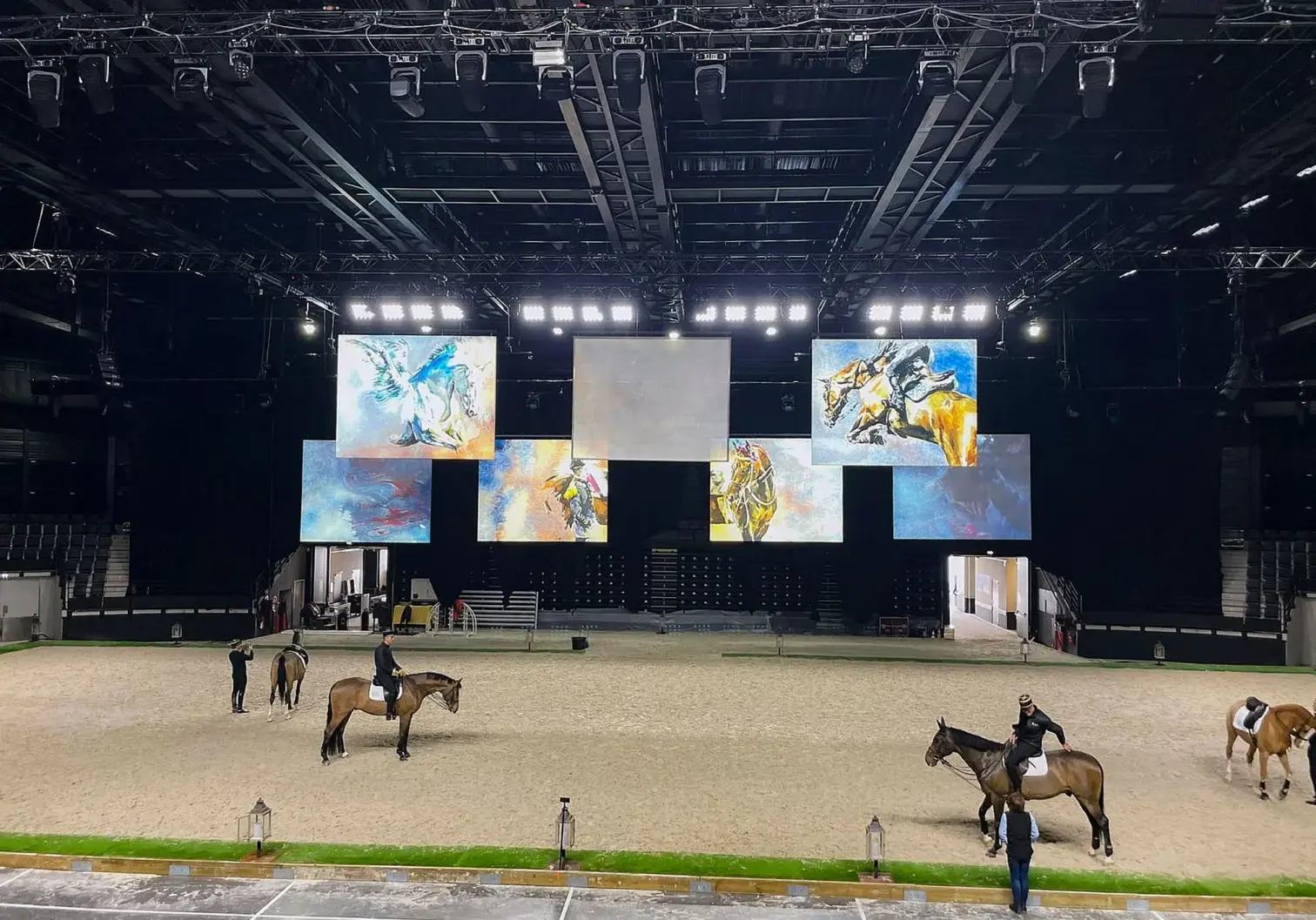
Inside the vast Grand Manège,nine illuminated panels are suspended above the arena. At first, they form a pale, almost dreamlike sky. Then the light changes and horses begin to appear within the paintings – larger than life, emerging where moments earlier there was only sky.
What looks almost digital is entirely physical: two printed images revealed through light.
The idea began with another stage. Laurence Sautet had introduced Anne-Sophie to the scenography for La Traviata, directed by Jean-François Sivadier at the Festival d’Aix-en-Provence, where panels were suspended above the stage. Anne-Sophie loved the concept but wanted to take it further by allowing the imagery itself to evolve.
For the new Gala, created under the artistic direction of Laurence Sautet, the paintings would offer another perspective on the horses rather than simply illustrate what was already happening in the arena. Together with painter Merlin Riand, Anne-Sophie explored how those horses should be portrayed and how they could contribute to the world of the Gala. Developed in close connection with the text written specifically for the performance, the imagery took on its own role in the unfolding story.
That decision became fundamental. If the paintings were going to change in front of the audience without becoming digital, the effect had to be built into the physical set itself.
Anne-Sophie contacted Big Image France early in the design process. Having worked with Big Image’s double-image Translight technique before, she knew it could allow one printed image to give way to another through light. This time, however, the ambition was on an entirely different scale.
The Grand Manège has a 75-metre-long performance arena. Anne-Sophie envisioned nine suspended panels, each measuring 4 × 5 metres – large enough to hold their own in the vast space, yet light enough to hover above the horses and riders.
“We needed both scale and lightness, which isn’t easy to achieve.”
The panels also needed to rise and descend during the performance, with the changing imagery moving with them. And as touring scenery, they had to work beyond the Grand Manège.
Big Image developed complete suspended aluminium lightboxes with illumination integrated into each frame. Two images could inhabit the same scenic surface and appear differently depending on how it was lit. Across nine lightboxes, this created 18 images for the performance.
As the Gala unfolds, one painted world gives way to another. The effect is so unexpected that Anne-Sophie suspects many in the audience assume there must be a digital element behind it.
“I think many of them assume it’s projected video. The way the horses appear on the reverse side is truly magical.” But there is no projection. Everything happens within the physical scenery, through the relationship between print and light.
Creating the visual effect was only part of the challenge. The lightboxes also needed to travel and perform reliably from one venue to the next.
Anne-Sophie had initially imagined the paintings printed on cotton, a material she had used with Big Image before. At this scale, and with the way the fabric needed to be tensioned, another solution was needed. Big Image suggested a synthetic fabric that could meet the requirements of the construction without compromising the Translight effect.
One detail was non-negotiable: the paintings couldn't be interrupted. Each 4 × 5 metre image was printed as one seamless piece, keeping Merlin Riand’s artwork intact at full scale.
Their monumental dimensions also complicated transportation. The aluminium team at Big Image’s Stockholm Studio therefore developed the frames in two sections, allowing them to travel more easily while appearing as one uninterrupted scenic element once assembled.
Depending on the venue, the scenography can use six, eight or all nine lightboxes. And the story doesn't necessarily end with these paintings. The aluminium structures can remain while the printed fabrics are replaced, allowing them to carry a completely new visual world in the future.
Once installed in the Grand Manège, the scale Anne-Sophie had been determined to preserve proved essential. The paintings have enough presence to belong in the vast arena, yet suspended above the horses and riders, they retain the lightness she had imagined from the start.
What remains is Anne-Sophie’s original idea: paintings that don't simply surround the performance, but become part of telling its story.
Some ideas don't come with an obvious way of making them real. That’s often where
the most interesting work begins.
Have an idea in mind? Let’s explore what it could become.
From bold ideas to finished reality, we make the extraordinary possible.